/ heritage & the idea / विचार एवं परंपरा /

Where Time Has a Horizon: The Zero Meridian of Ujjain

अवंतिका: खगोलीय शून्य रेखा और सृष्टि का स्वाभाविक समय

Long before civil conventions fixed the Prime Meridian at Greenwich in 1884, classical Indian astronomers recognized Ujjain as the navel of the earth. Here, where the Tropic of Cancer intersected the ancient meridian of reference, time was never measured from arbitrary midnight—it was born anew with each sunrise.

Interactive Principles · Hover to reveal

The Three Tenets of Vedic Chronometry

01Expanded

The Zero Meridian

शून्य रेखा · अवंतिका

Intersection of Tropic of Cancer & Prime Meridian

Centuries before Greenwich was designated in 1884, classical Indian astronomers recognized Ujjain (Avantika) as the natural prime meridian of Earth. Sitting precisely where the Tropic of Cancer intersects the ancient reference axis, all celestial ephemerides were calibrated from this point.

राक्षसालये देवतानां च मध्ये यत् समसूत्रम्...Surya Siddhanta (भूगोल अध्याय)
02Hover / Tap

Sunrise Over Midnight

सूर्योदय · सृष्टि का समय

Natural Horizon Origin vs. Arbitrary Midnight

Civil midnight (12:00 AM) is an artificial abstraction set at the darkest hour. Vedic timekeeping begins at Suryodaya (local astronomical sunrise), when the first solar ray crosses the horizon—aligning biological circadian rhythm and metabolic awakening with the cosmos.

उद्यन्नुद्यन्त्सूर्यः प्राणान् प्रेरयति...Atharvaveda (प्राण सूक्त)
03Hover / Tap

The 30 Muhurtas

अहोरात्र · काल विभाजन

Dynamic Seasonal Diurnal & Nocturnal Spans

A complete day-and-night cycle (Ahoratra) is divided into 30 Muhurtas (60 Ghati). Unlike rigid 60-minute Western hours, the 15 daytime Muhurtas (Dinamana) expand and contract gracefully with the changing solstices, capturing time as a living, breathing cycle.
पञ्चदश मुहूर्ताः अहः, पञ्चदश मुहूर्ताः रात्रिः...Taittiriya Brahmana
Chronological Epochs · 1500 BCE to 2026 CE

The Evolution of Vedic Horology

Trace the intellectual continuum across millennia—from Rigvedic solar mathematics to modern monumental tower horology.

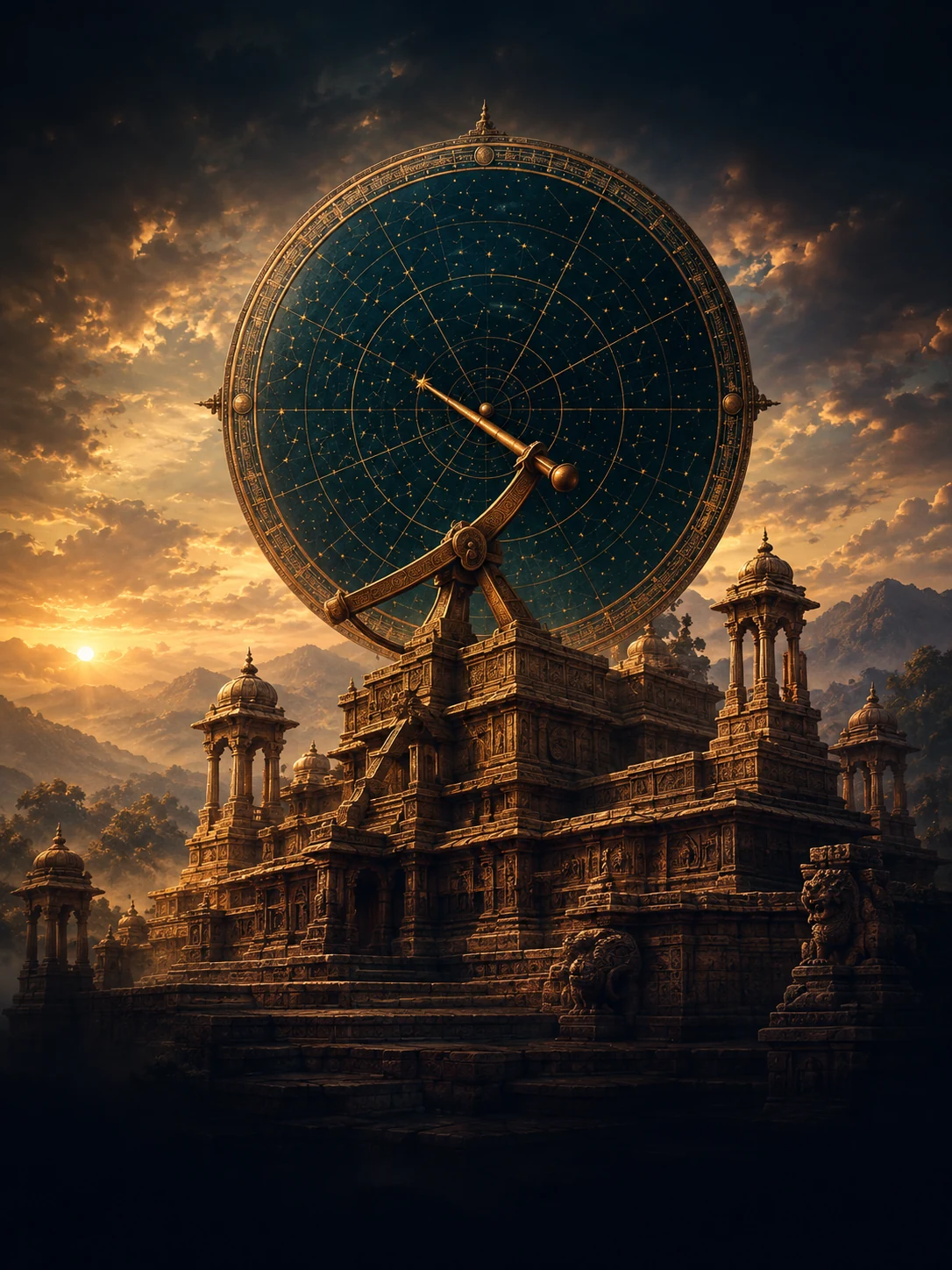
Ancient Temple Beneath the Celestial Wheel - Avanti Meridian
Epoch Continuum

Avanti Meridian

उज्जैन · समय की शून्य रेखा

Chronology

Vedic Chronology

Era Span

1500 BCE — 2026 CE

1500 BCEऋग्वेद काल

Rigvedic Antiquity

Astronomical hymns formulate the solar cycle into 12 lunar months, 30 daily Muhurtas, and 27 Nakshatras.

1000 BCEवेदांग ज्योतिष

Vedanga Jyotisha

Lagadha's astronomical manual introduces horizon gnomon shadow reckoning and Solstice calibrations.

500 BCEसूर्य सिद्धान्त

Surya Siddhanta

Mathematically fixes Ujjain as 0° Prime Meridian, calculating micro-intervals down to Truti (29.6 microseconds).

57 BCEविक्रम संवत्

Vikramaditya Era

Emperor Vikramaditya inaugurates the royal Vikram Samvat calendar, aligning civil governance with celestial ephemeris.

505 CEवराहमिहिर काल

Varahamihira

Compiles Pancha-Siddhantika in Ujjain, calibrating copper water bowls (Ghati-Yantra) to solar altitude.

1725 CEजंतर मंतर

Jantar Mantar

Monumental stone sundials and Samrat Yantras erected in Ujjain to measure local apparent solar time.

2026 CEनव पुनर्जागरण

Modern Rebirth

Ancient astronomical mathematics synthesized with high-precision micro-stepper horology in the Ujjain Tower Clock.

Circadian Ephemeris · Hover Phases

The Living Day: From Dawn to Pre-Dawn

Unlike artificial clock hands ticking evenly in a circle, the Vedic diurnal cycle is rooted in dynamic solar elevation angles. Hover over the celestial markers below.

🌅

Suryodaya (Dawn) · सूर्योदय

The zero point of the Vedic day. The solar disc breaches the horizon, activating Prana and opening the diurnal Muhurtas.

Cosmic QualityCreation & Awakening · सृजन
Ancient Canon · Surya Siddhanta
“That true vertical meridian which passes between Lanka and the celestial abode through Avanti (Ujjain) is the sacred prime meridian of astronomical observation.”
— Surya Siddhanta (भूगोल अध्याय)

Experience Living Vedic Horology

See the astronomical principles embodied in our interactive dial or explore the Panchang handbook.